

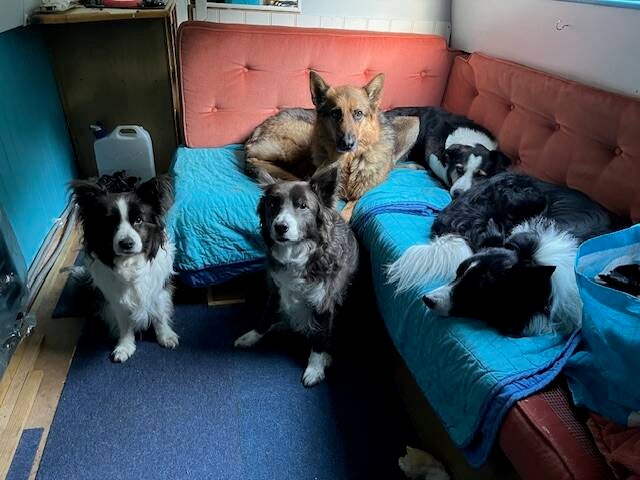
When Dave and his partner bought their boat in June 2025, they did not just step into a new way of living, they brought twenty additional legs – or five dogs with them. Daisy, a seven-year-old German Shepherd, Willow, Smokie, and Freckles, three eleven-year-old Collies, and Fury, a seven-year-old Collie.
For some, adding one dog to boat life feels like a leap. For Dave, it was simply the next chapter. Dogs have always been part of Dave’s adult life. A boat without them would never feel right. His GSD, Daisy was not new to the water. During the Covid lockdown, Dave had lived aboard a different boat, so Daisy was an experienced boat dog. However, despite being used to traveling in a motorhome and being raised on open land in the outskirts of Derbyshire, the others were all stepping aboard for the first time.
From Smallholding to Stern Deck
Willow and Smokie came from a friend, so they were technically rescues, though perhaps more accurately rehomed. Willow was eight years old when she joined the pack and had never left the smallholding where she was raised. She had not really been socialised beyond that world.
‘She is very reserved and can be quite timid,’ Dave explains. ‘We didn’t know how she would react to the boat.’
Boat life, with its movement, engine noise, towpath walkers, and changing scenery, can be a sensory overload for even the most confident of dogs. But Willow surprised her humans. Now she lies happily in the lounge while they cruise, and positions herself so she can see the back deck; present, observant, calm.
The others adapted as if they had been born to this life.
‘They all enjoy the freedom,’ Dave says. That freedom, with open towpaths, wide skies, and slow travel, seems to suit a working-breed pack.
Favourite Spots and Floating Routines
Each dog has claimed their territory.
‘Mainly as close to the fire as possible,’ Dave jokes.
When cruising, the dynamic shifts. Daisy is almost always on deck. She stands upright at the stern, looking out over the water, alert and steady, every inch the shepherd.
Smokie curls up on the bench beside ‘Mum,’ content but observant. The other dogs move between inside and outside, popping up to watch the world go by before retreating back down into the warmth and coziness of the cabin.

Freckles, one of the eldest, has chosen a quieter role. He curls up on the bed, watching the scenery pass through the front doors and bedroom windows. He chooses a softer vantage point; a senior crew member with definite senior privileges.
A fact that surprised Dave - the engine does not seem to unsettle them.
‘I think the warmth and even the noise from the engine has a soothing effect,’ he says. ‘Almost like white noise.’
This is a detail that speaks to how completely the ‘pack’ of five have absorbed the boat into their sense of normal. It is wholly and completely their home.
Locks, Tunnels, and the ‘Helping’ Dogs
Lock days are busy days. Dave and his partner often take one of the dogs along to ‘help,’ especially on staircase locks or when walking along a flight. Daisy and Smokie are the most reliable for this role, although they never have been known to pick up a windlass or push open a heavy lock gate.
‘They understand that once we approach a lock, we are going to be there some time,’ Dave explains. ‘They find a nice spot to lie down and watch.’
More impressively, they seem to have learned the sequence. When the boat moves out of the lock, they wait, as if they are aware that there is still gate-closing to be done before moving on.
Tunnels are different. All the dogs are kept inside – safe and sound. No risks are taken, nor are they needed. It is a quiet, practical approach to safety. Not dramatic, just steady and consistent. The dogs do not mind and are happy to perch in their favourite spots until the boat re-enters the new world on the other side of the tunnel.
The Gap Between Land and Boat
Boat life does come with learning curves. Freckles, whilst managing some health issues, has developed a habit of slipping into the gap between boat and bank while getting on or off when moored. It isn’t tense and he doesn’t panic.
‘He just sort-of stays still between the gap until rescued,’ Dave says.
Thankfully, someone is always on hand when it happens. They lift him out, then he shakes himself off and trots away ‘like it hasn’t happened.’ He suffers no long-term damage, just one of those small mishaps that become part of the rhythm of boat life.
Summer brings its own complications. Daisy and Smokie love the water, but not canal water unless there’s a sloped, eroded bank. But rivers are irresistible. If they see one, in they go - like a flash.
Dogs and their humans have adapted to the changing seasons of life afloat. While summer brings the heat and the abundance of greenery, winter means mud. No romantic gloss there, just truth.
‘Wet smelly dog. Muddy feet (or worse). Muddy towpath so wellies on rather than shoes.’
Five Dogs on a Towpath
Morning starts the same way regardless of cruising plans: thirty minutes of walking. Sometimes one person walks the dogs along the towpath while the other handles the boat, with either normal boat chores or readying it for a cruise. Other days are more ad hoc. Dave prefers towpaths over open fields. In a field, five dogs spread out, ‘more eyes everywhere.’ On a towpath, they stay in sight and tend to follow each other.
Cyclists can be one of the biggest hazards. Near misses happen. The responsibility weighs heavier with every additional set of paws.
‘[Cyclists] come flying round the corner, not expecting a pack of dogs.’
Dave is also conscious that one dog meeting five can feel overwhelming. When approaching another dog walker, he gathers the pack in, tuck into a gap, and let the other person pass. Sometimes the dogs get five minutes of play. Sometimes it’s just a nod and continue on their journey.
Interestingly, they’ve found other boaters tend to be more understanding than casual dog walkers in built-up areas. Boat dogs, it seems, exist in a slightly different social ecosystem.
‘There’s more of a sense of entitlement from some [non-boat] walkers. Like you’re in their space.’
But the space belongs to everyone, and Dave’s pack do their best to make it a nice place for all – boaters and locals alike.
Summer Nights and Quiet Moorings
If there is a moment that captures why this life works, it’s this:
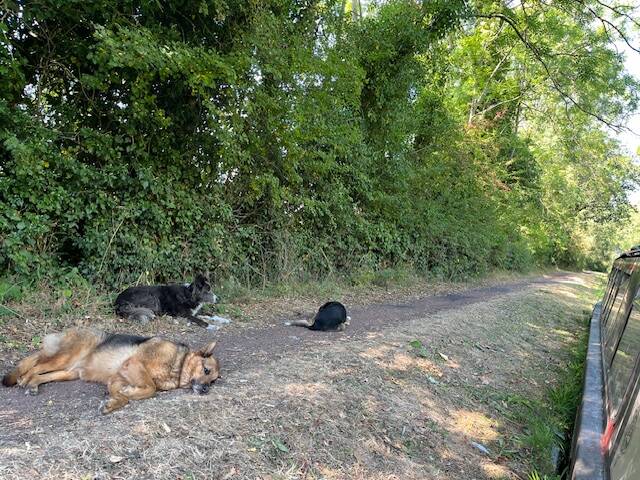
‘The summer nights. Sat outside on an empty section of towpath with no one around but us. Listening to music while the dogs are laid spread out on the towpath sunbathing.’
Five shapes stretched across the warm ground. No crowds, no rush. Just quiet companionship. Because of the dogs, they tend to moor away from popular spots. Less chaos means fewer surprises and more breathing space. However, it does make spontaneity that bit harder.
‘Feed the dogs, walk the dogs, change into nice clothes at the last minute, then one dog jumps up and you get paw prints on your trousers.’
He laughs about it. But there’s honesty there, too. Everything requires forethought when you have five furred lives to account for.
‘It’s hard work having to second think everything with five dogs in mind.’
And yet.
‘Go for it!’ he says, when asked what he’d tell his past self.
What Dogs Add to Boat Life
When I asked Dave how the dogs have changed his boating experience, he struggled to separate the two.
‘I’ve had dogs since being an adult. They are part of our life.’
That’s the point. The boat didn’t add dogs to his world; it simply adapted to include them. They bring grounding, comfort, companionship, structure. They also influence decisions: where to moor, when to walk, how to approach encounters.
Would he do it again? Without hesitation – absolutely!
The Right Dog for the Water?
Dave believes German Shepherd size is probably as big as he’d go. He jokes about not being a fan of ‘little laptop dogs,’ though quickly admits they’re probably just as rewarding for the right owner.
In truth, his pack reflects a certain kind of dog suited to this lifestyle: working breeds, outdoor-oriented, comfortable with movement, mud, and wide-open spaces. But more than breed, what stands out is consistency and routine. They stay on the boat until given the command to jump off. They wait at locks. They regroup when called. They’ve learned the rhythm – the rhythm of the cut.
Five dogs. One boat. Countless small adjustments.
And when the sun drops low over an empty stretch of towpath, and five bodies stretch out in the warmth beside the water, it’s clear this isn’t chaos.
It’s a pack. Afloat.
This article was originally posted on Robin's Substack on 7 March 2026. You can find a link below.
Add comment
Comments
Part of me imagines it would be a little bit of chaos having five canines aboard a boat. But this account definitely highlights the potential charms of sharing a water fairing life with dogs. I'm glad Dave and his partner have found a good rhythm with their furry pals.
I love the idea of being surrounded by dogs, even on a boat! It must be an ideal life.
Having lived in a caravan with three collies I can imagine both the chaos, and the rewards of five dogs on a boat - lovely to hear Dave's family's story.
I hope we cross paths someday x
Sounds like a lot of love on board.
Whenever there are dogs involved, love is always present!