

Most people who live in Britain (and many who don’t) are aware of the canals which snake all across the landscape of the country. About 1600 miles of canals (not counting the rivers and feeders) we know today was around 4,000 miles during the Golden Age of canals in the late eighteenth and early nineteenth centuries. All of them, from the cuttings to the locks themselves were built by men called ‘navvies’.
The life of a navvy was not an easy one. They lived in temporary camps, shanties, or huts near the construction sites for the canals, and later for the railroads. These camps were often overcrowded and basic, isolated from towns and villages. This isolation created a sense of self-governance, and they could regularly operate by their own rules. Some of these camps were almost like small villages with shops, pubs, and even schools and churches.

Navvies posing for the camera during the excavation works at Acton Grange on the Manchester Ship Canal (image public domain)
Navvies worked in ‘butty gangs’ or a tight-knit team (usually around a dozen men) who worked under a subcontractor responsible for various areas of the system. They were assigned tasks, often by self-appointed foremen, and expected each man to share the burden of the work equally. If someone wasn’t cooperating, he’d be ejected from the team. These butty gangs were the core workforces behind thousands of miles of canals. There was no machinery to make their jobs easier – they dug by hand and removed soil from the cutting by hand. It was hard work and not paid particularly well.
To say they enjoyed a drink would be an understatement. They relied on alcohol as a social lubricant and a means to cope with long, hard, and often dangerous labour. They would find their way to taverns and pubs, and sometimes drink themselves silly in their own camps. With drinking comes games and fights, which solidified social rivalry and masculine identity. This created a nightlife outside societal norms of the times. The odd times they did venture into towns and villages, they were treated as outcasts.
Labourers were often migrant workers, so to build a self-contained community, they developed a tradition of storytelling, drinking games, and improvised music and dancing. Their after‑hours world bound them together, even as it revealed the rifts running through their ranks. Rivalries, fighting, and competition were common, but shared labour hardship created a collective identity. Navvy communities maintained a rough but recognisable culture – they even had their own slang!
For all the roughness that clung to navvie life, including the drinking, the brawling, the tall tales shouted across firelit camps, their labour carved the waterways that still thread through Britain today. Every lock chamber, every embankment, every mile of towpath was won by hand, muscle, and lives lived hard at the edge of endurance. Without them, there would be no gentle weekend cruises, no heritage routes, no quiet mornings drifting through cuttings they blasted from the earth. So, wherever your journey takes you, leave space for a moment of stillness to honour the men who built these canals, and the sacrifices that made your passage possible.
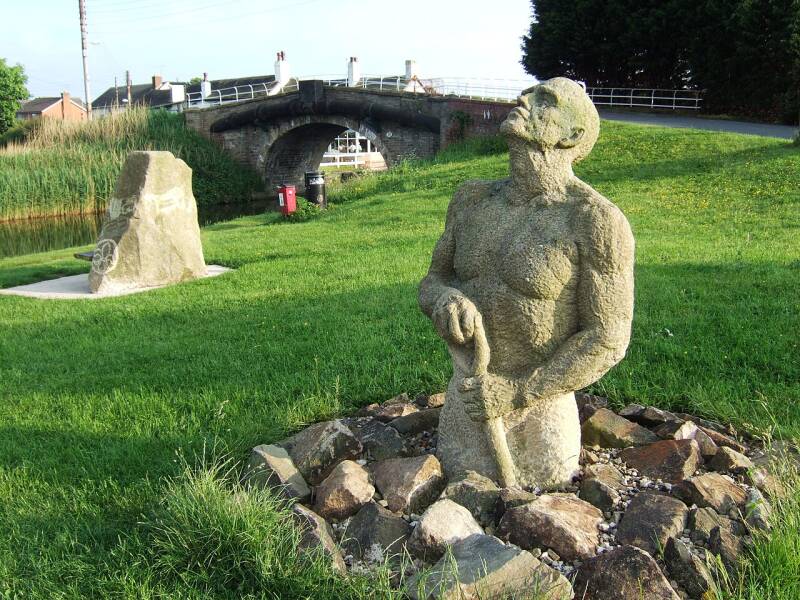
The "Halsall Navvy" by Thompson Dagnall, situated near the Saracen's Head pub in Halsall, Lancashire, England, where the first sod was cut on the Leeds and Liverpool Canal.
Photo attributions:
Image 1: https://commons.wikimedia.org/wiki/File:Navvies_posing_for_the_camera_during_the_excavation_works_at_Acton_Grange_on_the_Manchester_Ship_Canal_RMG_L5904.tiff
Image 2: Small-town hero, Public domain, via Wikimedia Commons & can be found at https://commons.wikimedia.org/wiki/File:Halsall_Navvy.JPG
Add comment
Comments
Reminded me how people so easily forget (then and now) the contribution from migrant workers
Honestly, the amount of hard work they had to do in order to create the canals we know today is just mind boggling!